Justin Bartak · Leadership · · 5 min read
Your Next Chief AI Officer Is Three Roles
Also published on Orbyt Labs
TL;DR
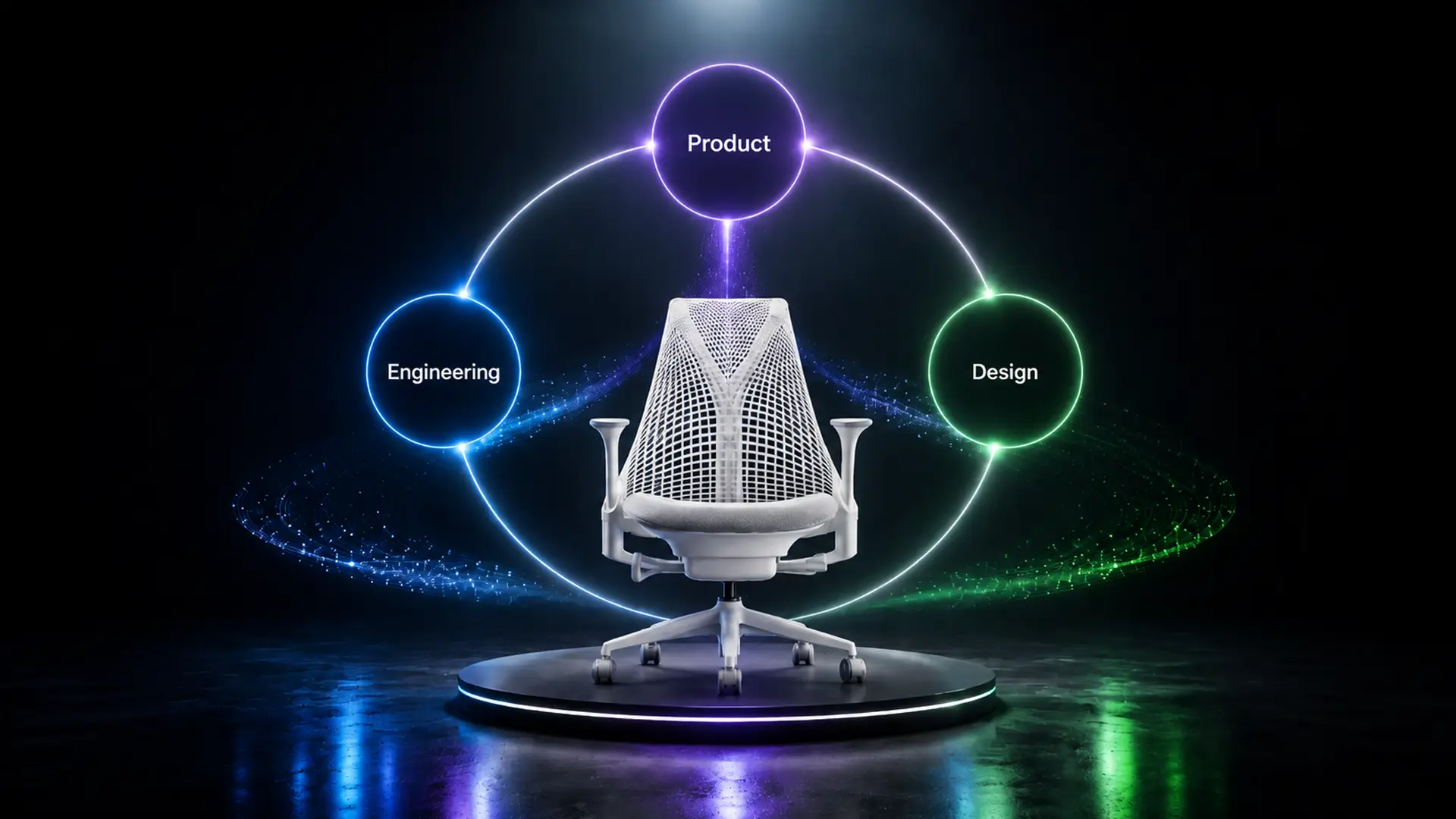
In 2026 the Chief AI Officer is not a technical hire. It is one leader who holds three chairs that used to belong to three people: the Chief Product Officer, the Chief Technology Officer, and the Chief Design Officer. AI-native products are designed, engineered, and governed as one motion, and the handoffs that split those jobs are gone.
A Chief AI Officer in 2026 is not a technical hire. It is one leader who holds three chairs that used to belong to three different people: the Chief Product Officer who decides what to build, the Chief Technology Officer who builds it, and the Chief Design Officer who decides how it looks and feels. The title says AI. The job is product, engineering, and design, fused into one.
For twenty years those were three separate offices, and the chief design officer was usually the last one filled. Separate budgets. Separate egos. AI collapsed them into one.
Not because the work got smaller. Because the work became a single motion.
Why the three chairs became one
The old org chart had a seam running through it, and Conway's law guaranteed the product would inherit it. Product handed a spec to design. Design handed a mockup to engineering. Engineering handed back something that resembled the mockup, mostly. Marketing polished whatever survived.
Every handoff was a translation. And every translation lost something.
AI-native products cannot afford those seams. In AI-native software, the model behavior, the interaction design, and the engineering are inseparable. You cannot write a spec for an AI feature and throw it over a wall, because the design emerges from what the model can actually do, and the engineering emerges from the design intent, in a loop so tight that pausing to hand it off breaks it.
The handoff is the bug.
One mind holding all three moves at a speed and coherence that three coordinating executives will never match. That is the whole thesis. Not that one person is cheaper than three. That one person is better, because nothing gets lost between them.
What the role is not
It is not an AI evangelist bolted onto an existing org. Bolt-on AI is debt you cannot see. Adding a chatbot to old software does not make you AI-native, and hiring a Chief AI Officer to bless that chatbot is theater.
It is also not a coordinator. A leader who aligns three teams is not the same as a leader who is the three teams. Coordination is the tax you pay for not having one mind in the room.
The 2026 Chief AI Officer sits above product, design, and technology because they can do all three, not because they schedule the meeting where the three argue.
Design is the chair everyone forgets
When people hear Chief AI Officer, they picture an engineer.
That is the tell.
The hardest part of an AI product is not the model. Anyone can call an API. The hard part is making something powerful feel calm, trustworthy, and obvious to a person who never read the documentation. The hard part is absorbing enormous complexity so the user never has to carry it. That is design, and it is the part that separates a product people trust from a demo people forget.
A Chief AI Officer who cannot design is doing a third of the job and calling it the whole thing. Governed automation is a design problem before it is an engineering problem. So is human control of AI. So is every interface where a machine does the work and a person has to decide whether to believe it.
Design is not decoration here. It is the discipline that decides whether the AI is usable at all.
What it looks like in practice
I have held all three chairs, and held them at the same time.
At Norhart, I ran three C-level roles at once, CTO, CDO, and CMO, leading product, design, and engineering across a $200M organization, and shipped a SEC-registered investment platform.
At Taxa, I designed the AI prototype that helped unlock $113M in funding in five months, and compressed 30-step tax workflows into 3.
I built Orbyt, a production platform, solo in 32 days.
None of that required a handoff. That is the point. The design, the product decisions, and the code came from the same place, so they never disagreed with each other.
How to know if you need one
The test is simple.
If your AI feature demos beautifully but no one trusts it in production, you have engineering and no design chair.
If your roadmap is a list of models instead of a list of outcomes, you have technology and no product chair.
If your product works and still feels like software from a company that does not know who it is, you have both and no taste.
A Chief AI Officer closes all three gaps at once, because they were never separate gaps. They were one gap that three org charts pretended to solve.
Final thought
The title will keep confusing people for a while. That is fine. The work is not confusing.
One person. From the first sketch to the last line of code. Accountable for whether the thing is worth building, whether it works, and whether anyone can stand to use it.
Three chiefs. One chair.
Related reading:
- The AI-Native Builder: Product, Design, Engineering
- Chief Design Officer Is Not a Luxury
- The Founder's Unfair AI Advantage
- Do You Need a Chief AI Officer? the decision, argued from inside the seat
- The First 90 Days of a Chief AI Officer. the operating plan once the seat exists
- How to Hire a Chief AI Officer. the search, run on receipts
Frequently asked questions
What is a Chief AI Officer in 2026?
In 2026 a Chief AI Officer is one leader who holds three roles that used to be separate: Chief Product Officer, Chief Technology Officer, and Chief Design Officer. AI-native products are designed, engineered, and governed as a single motion, so the role spans strategy, design, and code with no handoff between them.
Is a Chief AI Officer a technical role?
Not only technical. The title says AI, but the job is product, engineering, and design together. The model is the easy part. The hard part is making something powerful feel calm and trustworthy to a real person, which is design. A Chief AI Officer who cannot design is doing a third of the job.
How is a Chief AI Officer different from a VP of AI or Head of AI?
A VP of AI or Head of AI usually owns the technical function. A Chief AI Officer in the 2026 sense owns the whole surface: what to build, how it feels, and how it ships. It is the fusion of the product, design, and technology chairs, accountable end to end, not a specialist bolted onto an existing org.