Justin Bartak · AI · · 7 min read
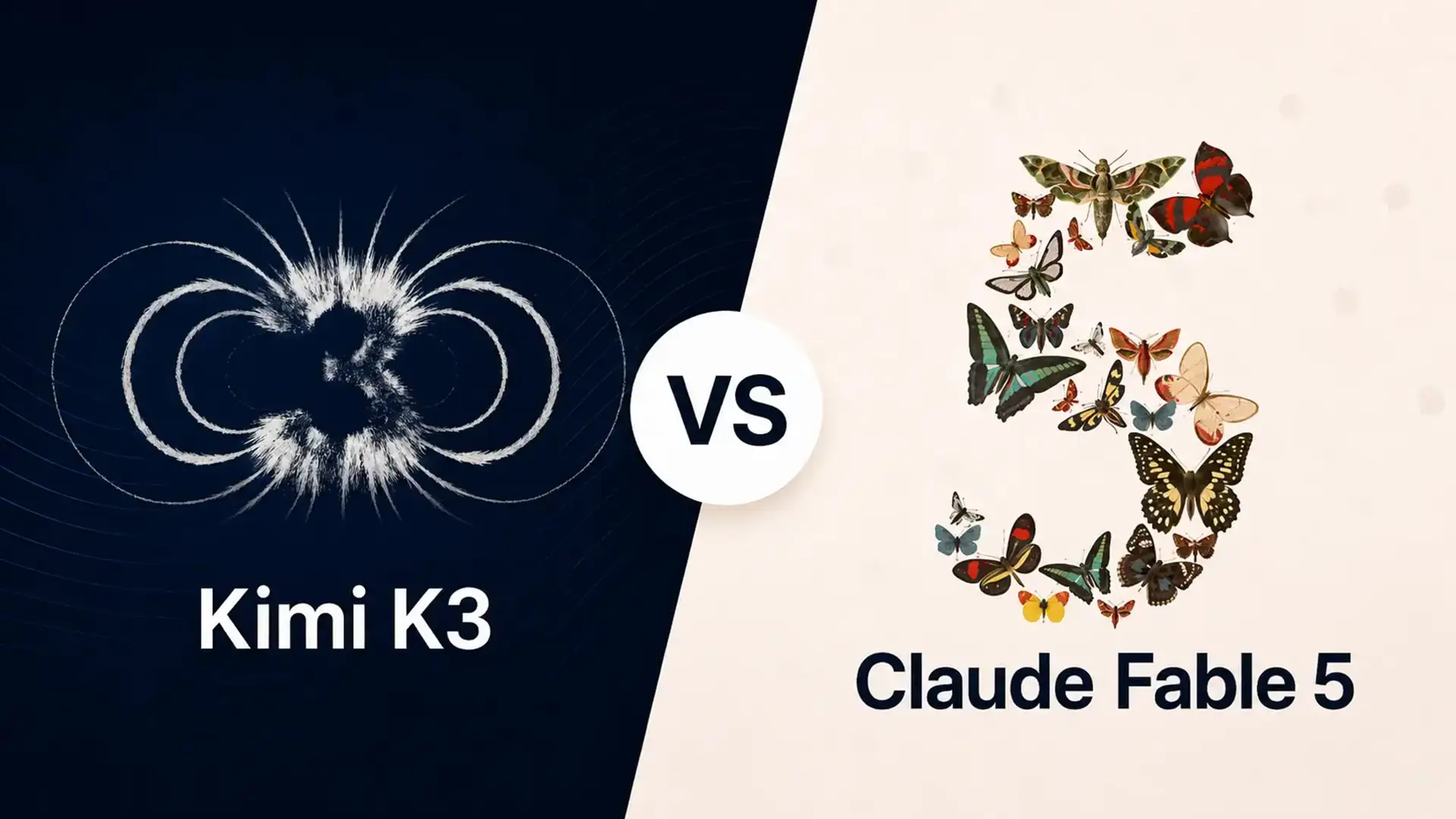
Kimi K3 vs Fable 5: The Open Frontier
Also published on Orbyt Labs
TL;DR
Kimi K3 landed July 16: a 2.8 trillion parameter open-weight model at frontier level for 70% less than Fable 5. It does not beat Fable overall. It changes the market anyway, because an open frontier cannot be export-controlled away. I watched Fable vanish for 19 days. Here is what K3 means if you build with AI.
Kimi K3 is the most important model release of the summer, and not because it is the best model. It is not. Moonshot AI's 2.8 trillion parameter release lands third on overall intelligence, behind Claude Fable 5 and GPT-5.6 Sol. It matters because it is open-weight, near-frontier, and roughly 70% cheaper, and because of the one property no closed model can offer: nobody can take it back. I spent June watching a government erase my primary model for 19 days. That is the lens for everything below.
The frontier just split into two poles: one you rent, and one you can keep.
What is Kimi K3?
K3 is Moonshot AI's frontier model, released July 16, 2026: a 2.8 trillion parameter open-weight multimodal reasoning model, the largest open-weight model ever shipped, with a 1 million token context window and an always-on thinking mode. It runs on two in-house architectural bets, Kimi Delta Attention and Attention Residuals. List pricing is $3 per million input tokens and $15 per million output. The full weights are due July 27.
One caveat before any comparison, because honesty compounds. Launch-week numbers are largely Moonshot-reported or drawn from API access. Until the weights are public and third parties rerun the suites, treat every benchmark below as a strong claim, not a settled fact.
How does K3 compare with Fable 5 and Mythos 5?
First, the naming. Fable 5 and Mythos 5 share the same underlying model. Fable 5 is generally available and carries additional safety measures for dual-use capabilities. Mythos 5 ships without those measures to approved organizations only. So capability-wise, a K3 comparison applies to both. The difference between them is not what the model can do. It is who is allowed to touch it, which turns out to be the theme of this entire story.
On the numbers that exist today: K3 scores about 57 on the Artificial Analysis Intelligence Index, third overall, behind Fable 5 at roughly 60 and GPT-5.6 Sol at roughly 59, and just ahead of Opus 4.8 at roughly 56. On LMArena's Frontend Code Arena it took the number one spot, passing Fable 5, a 17-place jump from K2.6. It posted 88.3% on Terminal-Bench 2.1, and it still trails the top closed models on broad agentic work.
| Kimi K3 | Claude Fable 5 / Mythos 5 | |
|---|---|---|
| Access | Open weights, due July 27 | Closed API; Mythos gated to approved orgs |
| Overall intelligence (AA Index) | About 57, third place | About 60, first place |
| Frontend coding (LMArena) | Number one | Passed by K3 |
| Broad agentic work | Trails the top closed models | Leads |
| List price, per million tokens | $3 in, $15 out | $10 in, $50 out |
| Can a government recall it? | Not once the weights are downloaded | Yes. Proven, June 12, 2026 |
Read that table honestly and the verdict is plain. Fable 5 is still the better model, and it is not close on agentic depth, which is where real building happens. K3 is the better price, the better frontend specialist on today's numbers, and the only one of the two that cannot be switched off by someone who is not you.
What does K3 mean for the market?
The gap closed to three points, and the price fell to a third. That is the headline. Nathan Lambert calls this wave the open-weights escalation, and the trajectory matters more than the snapshot: Moonshot jumped 17 arena places in one release cycle, and its previous model was already running 13-hour autonomous coding sessions with over a thousand tool calls.
When a near-frontier model is open, free to try, and priced at 30% of the leader, the floor price of intelligence resets for everyone. Every closed-model contract negotiated after July 16 happens in K3's shadow. You may never run it, and it still just became your negotiating leverage.
And notice how it was built: around US compute limits, not with the hardware Washington controls. Export policy shaped the frontier. It did not fence it.
What does K3 mean for the industry?
Here is where my June becomes relevant. Fable 5 released on June 9. On June 12 the US government export-controlled it out of existence overnight, mid-prompt, for every customer on earth. I wrote that story in The Fable the Government Erased. On June 30 the controls were lifted and Fable came back on July 1. Nineteen days, start to finish.
That episode taught the industry that a closed frontier model is a rented asset with political risk attached. K3 is the other half of the lesson, arriving three weeks later. Once open weights are downloaded, no directive can un-publish them. A government can recall the most capable closed model in the world, and it did. Nobody can recall a file that is already on a hundred thousand disks.
That asymmetry is now a permanent feature of the market. The closed frontier will keep the capability lead, and it will carry recall risk. The open frontier will trail by a few points, and it will be beyond recall. Every serious AI strategy now has to price both.
The frontier has a passport now. Plan like it.
I am coding in Fable 5 right now. Should I care?
I am writing this from a Claude Code session running Fable 5, the same model that vanished under me in June. So the question is not academic, and my answer is in two parts.
For Monday: nothing changes. Fable 5 is still the strongest builder I can rent, the agentic gap is real, and switching models on a launch headline is how you trade a known quantity for a press release. K3's launch numbers are Moonshot's homework. My harness has not graded it yet.
For the quarter: everything changes a little. When the weights land on July 27, K3 becomes a candidate builder that my loop can qualify like any other: run it against the same 11,372 tests and the same 35-dimension audit that every model faces on Orbyt. That is the whole point of loop engineering. The system holds the standard, so trying a new model is an experiment, not a migration. Meanwhile Orbyt's customers never touch the frontier at all; they are served by Sonnet 4.5 and other stable models, so no single model, and no single government, can take the product down.
If you build with AI, copy that posture, not my model choice. Rent the best instrument for the work. Keep a qualified fallback. Let your harness, not a leaderboard, decide when a challenger gets promoted.
What should a leader take from this?
Three things. The capability frontier is still closed and American, for now, and it is rentable but recallable. The open frontier is now Chinese, three points behind, 70% cheaper, and irreversible. And the only durable position in that market is the one that survived my June: architecture that treats every model as a component, verification that grades them all against the same bar, and zero single points of failure, political or technical.
Last month proved models can be recalled. This month proved open weights cannot.
Systems outlive both.
See the system that makes models swappable: Orbyt, built and run solo, the first product out of Purecraft.
Related reading:
- Every Fable Has a Moral. Mine Has Data. the Opus 4.8 versus Fable 5 build data, from the week Fable launched
- The Fable the Government Erased the 19-day shutdown that makes K3's open weights matter
- The Prompt Is Dead. Long Live the Loop. the loop that makes any model, K3 included, a swappable part
- I Run a Stack of Terminals. The Bottleneck Was Never the Code. the operator's view of a model-agnostic build
- Your AI Stack Needs a Foreign Policy. the sourcing strategy the two-pole frontier demands
- I Ship Slower Than the Models Change. the dated record of what this churn actually cost one operating company
- The Wrapper Won. what model commoditization means for where the value lives
- Frontier Development Is a Discipline. the lab habits that survive a two-pole frontier
Frequently asked questions
Is Kimi K3 better than Claude Fable 5?
Overall, no. On the Artificial Analysis Intelligence Index K3 scores about 57 to Fable 5's roughly 60, and it trails the top closed models on broad agentic work. But K3 took the number one spot on LMArena's Frontend Code Arena, passing Fable 5, at roughly 70% lower list price. Caveat: launch-week numbers are mostly Moonshot-reported until the weights land.
What is Kimi K3?
Kimi K3 is Moonshot AI's frontier model, released July 16, 2026: a 2.8 trillion parameter open-weight multimodal reasoning model, the largest open-weight model ever shipped, with a 1 million token context window and an always-on thinking mode. List pricing is $3 per million input tokens and $15 per million output. Full weights are due July 27.
What is the difference between Claude Fable 5 and Mythos 5?
They share the same underlying model. Fable 5 is generally available and carries additional safety measures for dual-use capabilities. Mythos 5 ships without those measures and is available only to approved organizations, a set the US government signed off on in late June 2026. Capability-wise a K3 comparison applies to both; the difference is who gets access.
Should I switch from Fable 5 to Kimi K3 for coding?
Not on a headline. Switch when your harness says so. If your verification layer is real, qualifying K3 as a builder is a trial you can run in days once the weights land, graded against the same tests as every other model. If you have no harness, no benchmark, K3's or anyone's, can tell you it is safe.