Justin Bartak · Engineering · · 8 min read
Verification Is the New Literacy
Also published on Orbyt Labs
TL;DR
When AI writes the code, the scarce skill is no longer authorship. It is verification. I cannot read all 425,000 lines of Orbyt by hand. The 11,372 tests and the 35-dimension audit harness read it for me, and they are the new literacy.
When AI writes everything, the scarce and decisive skill is verification, not authorship. Reading and writing code by hand is becoming optional. Proving that the system does what it must is becoming everything. The test suite and the audit harness are the new literacy.
You will not out-type the machine. You can out-verify it.
I cannot read all of Orbyt by hand anymore. It crossed 243,000 lines at launch on day 32. It is over 425,000 lines now. No human reviews that line by line, including the human whose name is on it. So I stopped pretending authorship was the job. The job is knowing, on every commit, that the thing still works.
Why authorship stopped being the bottleneck
For thirty years, the constraint was production. Someone had to type the code, and good typists were rare and expensive. We organized entire companies around protecting their hours.
That constraint is gone. Claude Code writes faster than any team I have ever staffed, and it does not get tired. Production is now cheap and nearly infinite.
When supply goes infinite, value moves to whatever stays scarce. What stays scarce is trust. Not "did the AI write code," but "can I prove this code is correct, safe, and shippable without reading it."
The moment code becomes free to produce, the only thing worth paying for is confidence that it is right.
What verification means when nobody reads the code
Verification is standing proof that a system meets its requirements, run by machines, on every change, with no human in the loop. It is not a code review by a senior engineer. It is a harness that fails loudly the instant behavior drifts.
On Orbyt that proof has a number: 11,372 tests. At launch it was 4,124 tests across 852 commits. The suite grew faster than I could ever read, because the agent writes the test alongside the feature, and the test is the thing I actually trust.
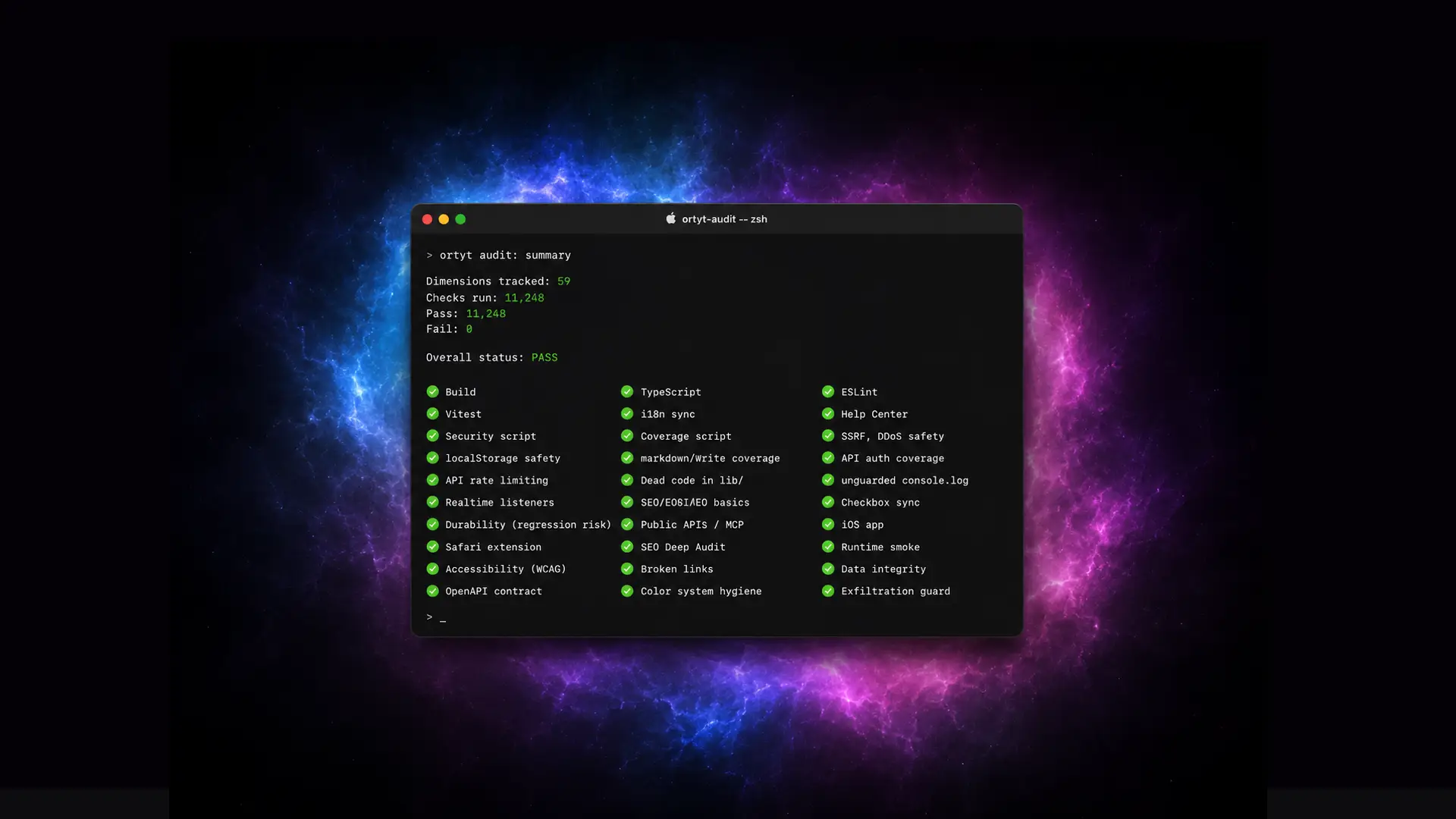
Tests are the literal layer. Around them sits a 35-dimension audit harness that checks build, types, lint, the fast-tier tests, fifteen locales, the iOS app, the Safari extension, a security battery, and accessibility on a single command.
I do not read the diff. I read the verdict.
How verification turned a frontier-model swap into a non-event
The clearest proof that verification beats authorship came when I changed the author mid-flight.
On June 9 I switched frontier models in the middle of a live Orbyt session, from Opus 4.8 to a newer model, with no migration plan and no ceremony. Nothing broke. I wrote the full data story in Every Fable Has a Moral. Mine Has Data.
The switch was uneventful for one reason. The context did not live in the model. It lived in the repo: the tests, the docs, the project log, the harness. The new model picked up cold, and the harness told me, on the first pass, that the codebase was still sound.
Then the government export-controlled that model out of my account overnight, and I had to swap again. I wrote that one up too, in The Fable the Government Erased. Same outcome. The harness made a forced, unplanned model change boring.
When your verification layer is real, the model is a procurement decision, not a platform bet.
That is the executive headline. Every frontier release, every price cut, every export rule, every model deprecation becomes a routine swap instead of a fire drill. You stop betting the company on one vendor's roadmap. You rent the best instrument for the week, and your harness keeps you honest.
Why verification is now a first-class capability, not a chore
Most organizations treat testing as overhead. A tax on shipping. Something you cut when the deadline tightens. That instinct was always wrong, and AI makes it fatal.
Here is the asymmetry. AI lowers the cost of writing code toward zero. It does not lower the cost of being wrong in production. A regulated payment path that silently breaks still costs you the customer, the fine, and the trust. The blast radius of a bad change is unchanged. The rate of change just went up by an order of magnitude.
| Capability | Pre-AI value | AI-native value |
|---|---|---|
| Writing code by hand | Scarce, high | Cheap, near-zero |
| Reading every diff | Feasible | Impossible at volume |
| Automated verification | Nice to have | The whole job |
| Judgment on what to verify | Implicit | The new literacy |
When production is infinite and the cost of being wrong is flat, the only lever left is the speed and rigor of your verification. That is why it has to be a first-class capability with a budget, an owner, and a standard. Not a chore you do if there is time.
This is also why AI-native systems pull ahead of bolt-on ones. A system designed so the harness can read it is a system humans can govern. One where AI was stapled on later usually has no such layer, and the debt stays invisible until it bites.
What verification literacy requires of a leader
You do not need to write the tests. You need to read the system the way you once read code. That is the new literacy, and it is a leadership skill before it is an engineering one.
Verification literacy means you can answer four questions about any AI-built system you own.
What must be true for this to ship? That is the spec, written as checks, not prose. If correctness is not encoded, it is not verified.
How do I know it is true right now? That is the harness output, on demand, in seconds. If the answer takes a human a day, you are not verified, you are hopeful.
What happens the instant it stops being true? That is the fail-closed behavior. On Orbyt, subscription gating fails closed by design. A broken check denies access rather than granting it.
What is not covered? This is the honest one. A 35-dimension audit covers thirty-five dimensions. The gaps are where the next incident lives, so name them out loud.
A leader who can ask those four questions does not need to read a single line.
The practical move for the next ninety days
Stop measuring your AI investment by how much code it produces. That number is going to infinity, and it tells you nothing.
Measure it by what you can verify without a human in the loop. Count the checks. Time the harness. Track how many production paths fail closed. Make verification coverage a board-level metric, the same way you track revenue or churn.
Then staple a rule to every AI initiative. No feature is done when the model says it is done. It is done when the harness says it is done. The model is the author. The harness is the editor, the auditor, and the gatekeeper, and only the gatekeeper gets to ship.
That single rule is the difference between AI that compounds and AI that quietly accrues risk you cannot see.
I built Orbyt this way from the first commit, solo, in 32 days, for about $400. The reason one operator could ship and keep shipping a 425,000-line production product is not that I write fast. It is that I never have to trust the code. I trust the proof.
The author is now a commodity. The verifier is the franchise.
Every fable has a moral. Here is this one.
When the machine writes everything, the person who can prove it works owns the outcome.
See it in practice: Orbyt, built solo in 32 days, the first product out of Purecraft.
Related reading:
- I Cannot Read My Own Codebase. I Ship to It Daily.
- Every Fable Has a Moral. Mine Has Data.
- The Cost of Bolt-On AI Is Debt You Cannot See.
- Using Claude Code Is Like No One Ever Saying No to You when no one says no, the harness becomes the no
- Your Tests Are the Spec Now. the spec, written as checks instead of prose
- Codex Accuses. Claude Convicts. verification with a second model, and why the auditor is not allowed to write
- You Can Vibe a Product. what verification makes possible
- The Prompt Is Dead. Long Live the Loop. verification is the gate at the end of every engineered loop
- I Ran 830 Agents in One Long Horizon Session. what happens to verification when one session spawns 830 agents
- Long Horizon Agents Don't Fail. They Pass. what a suite of 11,372 tests still cannot see, and the oracle that catches it
Frequently asked questions
Why is verification more important than writing code in AI-native development?
Because AI makes writing code nearly free while the cost of being wrong in production stays flat. When the supply of code goes infinite, value moves to whatever stays scarce, which is trust. Verification is the only thing that proves an AI-built system is correct, safe, and shippable without a human reading every line.
How do you verify AI-written code you cannot read?
You replace human reading with machine proof. On Orbyt that means 11,372 tests written alongside the features, plus a 35-dimension audit harness that checks build, types, lint, fifteen locales, the iOS app, a security battery, and accessibility in one command. You read the verdict, not the diff, on every change.
How does a verification layer make switching AI models safe?
Because the context lives in the repo, not the model. The tests, docs, project log, and audit harness let a new model pick up cold. I switched frontier models mid-session twice in June 2026, once by choice and once when export controls forced it, and the harness made both swaps uneventful. The model becomes a procurement decision.