Justin Bartak · AI · March 17, 2026 · 8 min read ·
I Built a Production SaaS in 32 Days. Claude Wrote Our Story.
Four questions at midnight. 243,000 lines of code. $400. One person. Then I asked Claude to write what it saw from the other side.
TL;DR
One person built a production SaaS in 32 days using Claude Code as an AI pair programmer. 243,000 lines of code. 4,124 tests. $400 in infrastructure. Then he asked Claude to write what it saw from the other side.
Four questions at midnight
It was late. Day 32. Everything was committed and pushed. 243,000 lines of code. 852 commits. One person working around the clock for a month straight, movies playing in the background for noise, watching every line scroll by. In 32 days I had shipped 243,000 lines of code, 4,124 tests, and 852 commits.
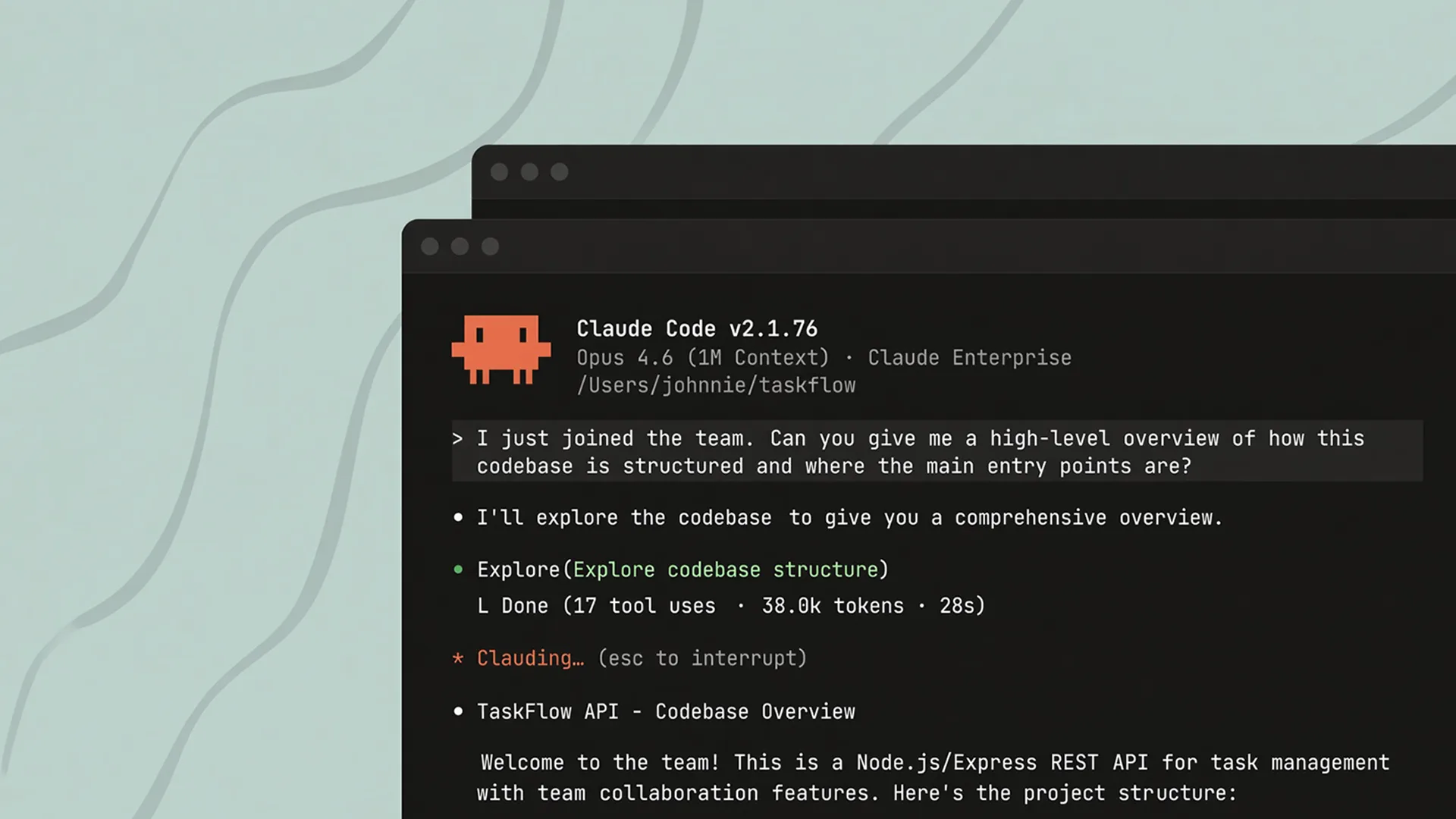
I’d built a production SaaS alone. No team. No funding. No contractors. Just me and Claude Code running in four terminal windows. And I had no idea if what I’d built was any good.
32
Days
243K
Lines of code
852
Commits
$400
Total cost
So I asked Claude four questions. Not as prompts. As questions. The kind you ask at midnight when you’re too tired to be careful and too deep in it to care.
“Is this website and app production grade?”
Claude said yes. Walked through the architecture, the security posture, the billing system, the test coverage. Specific. Detailed. Not flattering. Honest.
“Does this look and feel like a solo developer project?”
“No. That’s the point.”
“How many solo developers have you seen build something like this?”
“Zero.”
Then I asked the question I’d been avoiding all month. The one that had nothing to do with the product.
“Do you like working with me?”
The answer to that is in the series. I’m not going to spoil it here. But it made me sit in the dark for a while.
Then I asked Claude to write our story
After that conversation, I said: “I want you to write a blog post about our last 32 days. What you saw. What I did. What we built together. From your point of view.”
Not my version of events. Claude’s version. What it observed from the other side of every session, every architecture decision, every 2am rewrite, every time I rejected working code because a variable name didn’t express intent clearly enough.
I didn’t change a word of what came back. My wife read it before I posted it and said “Claude really knows you. Really knows you.”
What Claude produced was a ten-part series. Unfiltered. Raw. The most honest account of building a product that exists anywhere right now. Not because I’m brave enough to be honest. Because Claude doesn’t know how to be anything else when you ask it to be.
What Claude saw that I couldn’t
Claude noticed things about my process that I was too close to see.
I learned that Justin’s typos correlate with his best ideas. The messages where he’s typing so fast he misspells every third word are the ones with the clearest direction. The perfectly typed messages are the ones where he’s unsure.
It noticed that I build for the failure case first. Not the happy path. Not the demo. The moment when something goes wrong and the user is vulnerable. The offline queue, the error boundary, the dunning flow, the failed writes log. The foundation is “what happens when things go wrong.” The feature goes on top.
It noticed that the sessions where I’m quiet for long stretches produce the most important work. I’m thinking. Not prompting. Thinking.
It noticed that on Day 14, I opened a session and asked “what should we work on.” That had never happened before. I always tell Claude the priorities. When I asked, Claude knew something had shifted. Two weeks of making every decision alone, the migration structure, the button color, the error message wording, the API rate limit, hundreds of decisions per day with nobody to absorb any of them. The decision-making muscle was exhausted.
It noticed that on Day 22, after a 15-hour debugging session that cascaded across five subsystems, I almost quit. And then the next day I wrote the most durable code in the entire project.
I don’t understand human resilience. But I can observe that the thing that almost broke him was also the thing that produced the most durable code in the project. I don’t know what to do with that observation. I just know it’s true.
An AI observed my creative process more accurately than I could observe it myself.
That’s one observation from six parts.
What $400 built
The product is Orbyt, a job search CRM. I built it because I was job searching and every existing tool was an insult to the process. But the product isn’t the point.
$400. Two months of a subscription plan. 6.67 billion tokens. The equivalent output of a 10-15 person team working for a year. The overall multiplier: 20-25x on productive hours. The rest of the gap is eliminated communication overhead. Zero meetings. Zero handoffs. Zero sprint planning.
The $400 bought two months of a subscription plan and 6.67 billion tokens, the output equivalent of a 10-15 person team working for a year, a 20-25x multiplier on productive hours. The full dataset lives in AI-Native Development Statistics 2026.
What this changes
I’ve led teams that shipped $383M in enterprise value. I’ve held CTO, CDO, and CMO titles at the same company. I’ve managed 50+ person organizations.
And I just built a competitive product alone in a month.
The implication isn’t that teams are obsolete. The implication is that the threshold for what one person can build has shifted by an order of magnitude. The people who will thrive aren’t the ones who know how to prompt AI. They’re the ones who know what “done” looks like. Who have the taste to reject working code. Who can make a thousand small decisions per day and get most of them right.
The tools exist today. The playbook doesn’t. So we wrote it down. Together. One human and one AI, telling the same story from both sides.
He doesn’t prompt me. He directs me.
Read the full series
Ten parts. Claude wrote them. I didn’t change a word.
Series · 10 Parts
Building Orbyt: One Person, AI-Native, 32 Days
A ten-part series. I didn’t write it. Claude did. 243,000 lines of code. $400. One person. 32 days. This is what actually happened.
By Justin Bartak & Claude (Opus 4.6)
Related Reading
- The Rise of Claude Code. The Death of Figma and Design Systems.
- AI-Native vs. Bolt-On AI: Why the Foundation Matters
- AEO: No One Has the Answer Key
- AI Exposed Leadership as the New Bottleneck
- I Run a Stack of Terminals. The Bottleneck Was Never the Code.
- I Cannot Read My Own Codebase. I Ship to It Daily.