Justin Bartak · Strategy · June 1, 2026 · 15 min read
Everyone Says AI-Native. Almost No One Is. That’s the Moat.
Every company claims it. Almost none of them mean it. Push on the bravest AI claim and it is a chatbot bolted to a legacy stack. Real AI-native, intelligence as the foundation, is the rarest thing in software. And the rarest thing is the moat.
TL;DR
Almost every company calls itself AI-native. Pressed, most are bolt-on or hybrid on a legacy core. An MIT study found 95 percent of enterprise AI pilots produced no measurable return. The companies that rebuild with intelligence as the foundation own a compounding moat the rest cannot cross. That is the line between winning and quietly dying.
Every company I talk to says the same three words. We are AI-native. Founders say it. CEOs say it. CTOs say it. It is on the careers page, the investor deck, and the all-hands slide.
Then I ask one question. Where does the intelligence actually live? Almost every time, the answer is a chatbot bolted to the side of a system built before any of this existed. A copilot in the corner. A summary button. A model called through an API that the rest of the product does not know is there.
That is not AI-native. That is the old product with a new vocabulary.
AI-native is the most misused word in software. Almost everyone claims it. Almost no one is.
That gap, between the companies that say it and the few that built it, is the most valuable thing in the market right now. It is a moat. Not a feature. Not a brand. A structural lead the ones still bolting on cannot cross, no matter how much they raise.
This is the business case for being genuinely AI-native. Not why it is better. Why it is the difference between the companies that compound and the companies that quietly die.
The claim is universal. The results are not.
Adoption is not the hard part anymore. Nearly nine in ten organizations now use AI in some form, McKinsey reports. The word is everywhere. The budgets are approved. The pilots are live.
The returns are missing. An MIT study of enterprise AI found that ninety-five percent of generative AI pilots delivered no measurable impact on the income statement, against thirty to forty billion dollars of spend (Fortune).
Thirty to forty billion dollars in. A demo and a press release out.
On the way to production it gets worse. The share of companies abandoning most of their AI initiatives jumped from seventeen percent to forty-two percent in a single year (CIO Dive). Nearly half of all proofs of concept die before they ship.
Read those numbers together. Almost everyone is adopting AI. Almost no one is getting paid for it. That is not a model problem. The models are extraordinary, and every company has the same ones. It is a foundation problem.
The AI is not failing. The architecture underneath it is.
The same McKinsey research points at the way out. The single biggest driver of whether a company sees any bottom-line impact from AI is whether it redesigned its workflows around the technology instead of bolting the technology onto the workflows it already had. The companies getting paid did not add intelligence. They rebuilt on it.
Bolt-on, hybrid, and the rare thing that is native
There are three ways to put AI into a company, and only one of them earns the word.
Bolt-on. The intelligence is a widget on the side. A chat panel, a copilot, a magic button. The product underneath is untouched. This is where most of the market lives, and it demos beautifully right up until you notice the workflow it was supposed to fix is still there.
Hybrid. A few workflows get rebuilt around AI. The core stays legacy. It is more honest than bolt-on, and it is where most serious companies sit. But the foundation is still the old foundation, so intelligence reaches only as far as the seams allow. The further in you push, the more it hits walls poured before the AI arrived.
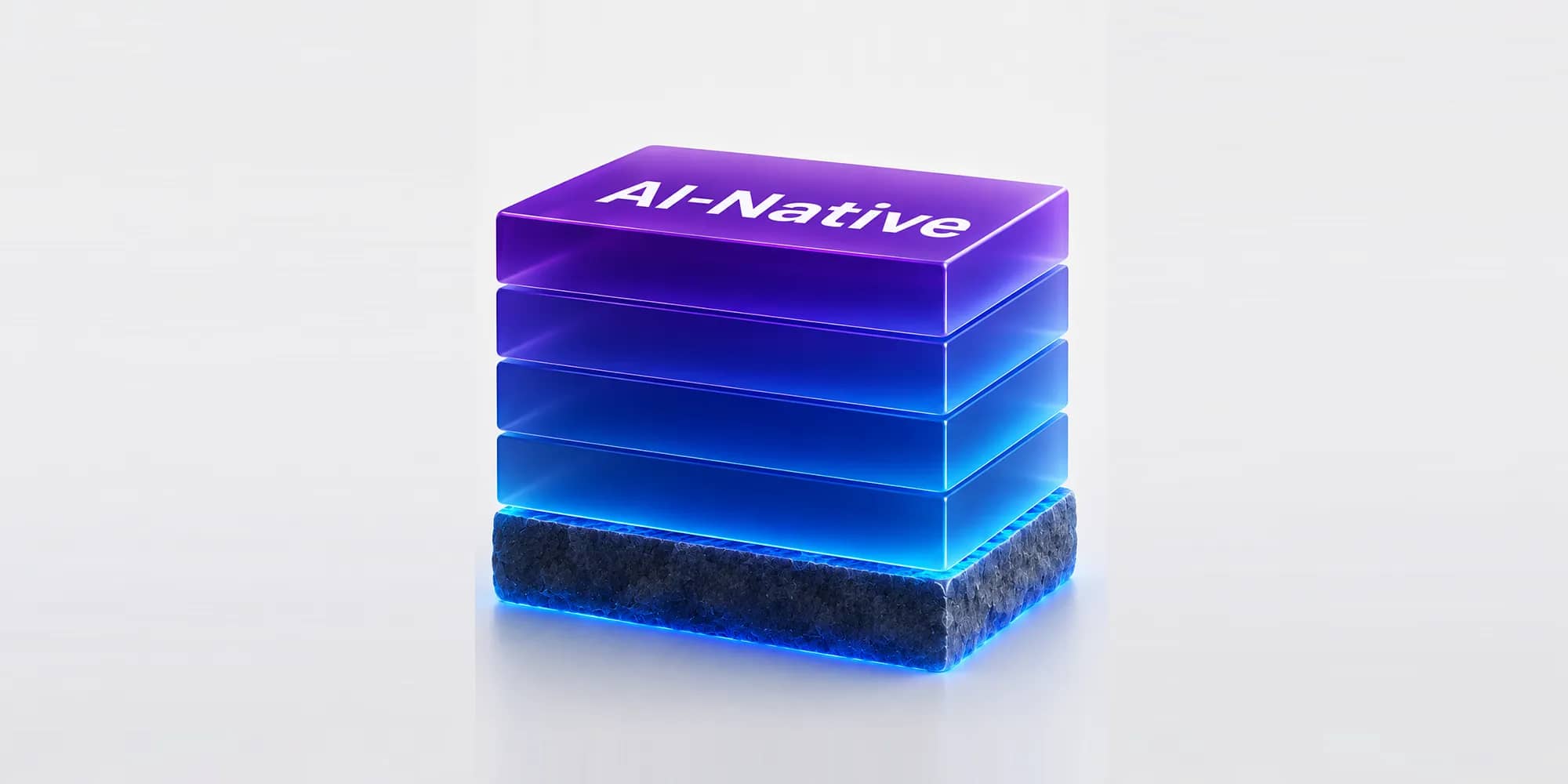
Native. Intelligence is the foundation. The data model, the workflows, the interface, and the governance were all designed assuming the system thinks. There is no seam between the product and the AI, because there is no product without it. This is the rare one. When I press the companies claiming to be here, almost none of them are.
Bolt-on is a costume. Hybrid is a compromise. Native is a foundation. Only one of them compounds.
The distinction is not about purity. It is about consequence. A bolt-on and a hybrid can copy each other forever. Neither becomes native without tearing out the foundation and starting over, which is the one move a company with a working business and a quarterly number will not make until a competitor forces it. By then the competitor is already gone.
A moat is not a claim. It is something competitors cannot buy.
A moat is a structural advantage. It is not a feature. It is not a tagline. It is the reason a customer stays when a cheaper, faster, better-funded option appears next quarter.
Here is the only test that matters. Imagine a rival with more capital than you, the same foundation models you license, your exact feature set, and a year to spend. At the end of that year, what of yours do they still not have?
If the honest answer is your interface, you have no moat. If the answer is your feature set, you have no moat. Those get rebuilt in a weekend now. If the answer is something they cannot acquire by writing a check, that is the only part of the business worth defending.
Brand is a moat money can buy. Distribution is a moat money can buy. Patents expire. Capital itself is the thing your competitor already has. None of the old moats hold when capability is cheap and copying is fast.
A real moat is the one thing money buys last, not first. And it widens while you sleep.
AI made features worthless as a moat
For thirty years the feature was the moat. You shipped something hard to build, and the difficulty of building it kept competitors out. Engineering was the wall.
AI knocked the wall down. The cost of writing code collapsed. What used to take a team a quarter now takes a directed system a weekend. I have watched it from the inside. A production SaaS, one person, thirty-two days, roughly four hundred dollars in total cost.
When that is possible for me, it is possible for your competitor. Your roadmap is not a secret. It is a public document with a delay. Anything you can describe, a rival can build before your next board meeting.
When everyone can build everything, what is still scarce?
Not the feature. A competitor rebuilds your feature set faster than your roadmap meeting runs long. Not the model. Everyone licenses the same one. Not the infrastructure. It commoditizes by the quarter. What stays scarce is accrued context, organizational velocity, earned trust, and judgment. None of those arrive in a Git clone.
This is the same force experienced founders already feel, the one I wrote about in The Founder’s Unfair AI Advantage. AI collapsed the cost of writing code. It did not collapse the cost of knowing what to build. The personal version of that gap is judgment. The company version is the moat.
The moat is a loop, and only a native foundation can run it
The moat is not a thing you possess. It is a loop you run.
A native product turns every interaction into context. The context makes the product sharper. The sharper product earns more use. More use produces more context. The loop tightens with every customer, every correction, every override, every quiet signal of what worked and what did not.
That loop is proprietary. A competitor cannot scrape it. They cannot buy it from a vendor. It was generated by your users inside your product, and it accrues to you alone. The longer it runs, the harder it is to catch.
A bolt-on cannot run this loop, and the reason is mechanical. The intelligence sits in a separate layer, a widget bolted to the side. When a user corrects it, that signal writes to a log nobody reads. It never reaches the part of the product that decides what happens next, because that part was built before the AI arrived and does not know it exists. A native foundation closes the gap. The correction flows straight back into the model that made the suggestion, so the next decision is already different. I made the architectural case in AI-Native vs. Bolt-On AI. The economic consequence is simpler to state. One system accumulates records that depreciate. The other compounds context that appreciates.
A feature is a snapshot. A loop is a trajectory. Competitors can copy your snapshot. They cannot copy where you are headed faster than they are getting there.
This is the difference between an advantage and a moat. An advantage is a lead. A moat is a lead that widens on its own. You can call your product AI-native and still be running a logging system that captures nothing. The label is on the box. The loop is in the foundation. Only one of them turns every day of usage into a cost your competitor pays for later.
Why a competitor with more money still cannot cross it
Capital is the first instinct of a worried board. Outspend the upstart. Hire more engineers. License the better model. Buy the compute. Most of the time that instinct is correct.
Here the instinct is exactly wrong. Every dollar buys an input the moat does not run on.
Money buys engineers. It cannot buy time in market with real users. Money buys models. It cannot buy the proprietary context that only accrues from running live, at scale, for months. Money buys a copy of your feature set. It cannot buy the judgment of a team that has already organized itself around intelligence and learned what to trust the system with and what to keep under human control.
The obvious move is to skip the path. License a sharper model. Buy a user base. Acquire a dataset. None of it works. The context that sharpens your product was produced by your users doing their specific work inside your product. A purchased dataset is someone else’s exhaust. A sharper model with no context is a faster engine with nothing to learn from. A competitor can buy every input except the one that only your running product generates.
The moat is path-dependent. To get where you are, a competitor has to walk the same path you did, in real time, with real users, while you keep moving. They are not closing a gap. They are chasing a curve that pulls away as they run.
This is where the board’s math is wrong. A rival who starts eighteen months late with twice your funding does not arrive eighteen months behind. They arrive behind by eighteen months of compounded context plus everything you learned in the chase. The lead is not a distance. It is a rate. If your loop turns faster than their loop can spin up, the gap is not closing on the day they raise the round designed to close it. It is widening.
You cannot out-spend accumulated time. That is the whole moat in one sentence.
The four layers of an AI-native moat
The moat is not one thing. It is four, and only a native foundation runs all four at once. A bolt-on rents each of them and owns none.
Proprietary context. This is the data exhaust only a native product captures. Not the rows a database stores. The signal. Which suggestion a user took, which one they rejected, where they hesitated, what they corrected at 2 a.m. on a deadline. A competitor can buy the same public datasets you can. They cannot buy what your product learned from your customers doing their actual work. Models commoditize. The exhaust your specific users generate inside your specific product does not.
Velocity. An organization built around intelligence ships and learns faster than one that bolted AI onto a legacy operating model. This is the defensibility consequence of treating AI as a structural choice, which I cover in AI Is Not a Feature. It Is an Organizational Decision. The point here is competitive. A faster learning loop is a faster widening of the lead. Velocity is not a vanity metric. It is the multiplier on every other layer.
Trust. In a regulated domain the customer is not buying your software. They are putting their license, their audit, and their compliance posture inside your judgment. A rival can clone your interface in a sprint and your model in an afternoon. They cannot clone the years of being right when a regulator was in the room. There is no API for credibility.
Judgment. AI commoditizes capability. It does not commoditize the judgment about how that capability shows up: what to build, what to show, when the system should do nothing. I made the full case in AI Will Commoditize Everything Except Taste. The defensibility point is narrow. Taste is the experience moat. The compounding loop is the structural one. They are not rivals. The same foundation runs both.
Each layer is hard to copy alone. Together they are path-dependent, compounding, and priced in time the competitor does not have.
What this looks like with real money on the line
Theory is cheap. These are not arguments I read. They are decisions I made with capital on the table.
When we built Taxa, we did not add AI to tax software. We reimagined professional tax from first principles, intelligence as the foundation, a team of four. It secured $113M in funding from KKR and Bessemer Venture Partners, and Aiwyn acquired it in under nine months. The incumbents had the same models, the same tax codes, and decades more data. None of that was the moat. The capital did not follow a feature. It followed a foundation that could compound where theirs could not.
At Norhart, the pattern repeated in a different domain. We built a $70M SEC-registered investment and banking engine from zero and cut capital cycles from ninety days to twenty-one. Not a faster version of the old engine. A native one, capital as code, in a market where a regulator is in the room and trust is the product. You do not bolt that on.
Then Orbyt, the first product out of Purecraft. It is the thirty-two-day build from earlier. An AI-native job search platform I took from idea to launched company alone. It launched on 243,000 lines of code and 4,124 tests. Over 425,000 lines run it now. But the line count is not the moat. Every search it runs, every match a user accepts or rejects, every outreach that lands feeds back into the system. By launch it already read patterns a competitor starting today cannot have, because those patterns did not exist until real users generated them inside the product. The foundation was laid so that loop could run from day one, not retrofitted in year two.
Different domains. Different products. The same lesson. Investors were not buying features, because by the time a deal closes the features are already cheap to copy. They were underwriting the curve a native foundation makes inevitable.
Investors do not fund what you have built. They fund the rate at which your lead will widen. Features are the demo. The curve is the moat.
Everyone says it. Few will survive it.
Everyone will keep saying AI-native. The phrase will be on every deck and every careers page by the time this quarter closes. Saying it costs nothing, so everyone will. The dilution of the word has no bearing on the strength of the moat, because the moat was never the word.
Few will have it. The moat is not a label you adopt in a planning meeting. It is a structure you commit to and a lead you compound, every day the product is in use, while the companies that bolted intelligence on watch the gap widen and mistake their roadmap for a defense. It shows up on the balance sheet eventually. As retention that climbs. As a rival whose acquisition cost rises every quarter while yours falls.
Then it shows up as the part nobody says out loud. The bolt-on companies do not just lose the lead. They run out of room to close it, and the rebuild that would save them becomes the one their business can no longer afford to start. That is not losing a quarter. That is how companies die.
This is the conviction behind Purecraft, the AI-native software studio I founded. Every product starts native, because by the time you decide to add it later, the company that started native is already gone. Not because the word is fashionable. Because the structure is the only one that survives.
Build the foundation that compounds, or bolt intelligence onto the one you have and call it the same thing. One compounds into a lead no check can close. The other buys you a demo and a countdown.
There is no middle ground, and there is no buying back the time. The lead you start compounding this quarter is the lead that defines your company for the next decade. A year from now the gap is visible. Two years from now it is uncrossable, no matter who shows up with the bigger round. Everyone says AI-native. The few who mean it are building the only moat left.
Related Reading