Justin Bartak · AI Org · · 13 min read
My C-Suite of Agents Named Themselves.
TL;DR
I built a twelve-seat C-suite of AI agents at Orbyt, with a Chief of Staff who folds every department into one weekly briefing on my desk. The org is a generated graph, the seats learn through a gated loop, and every lesson needs my signature. Here is how it runs and where it breaks.
Meet the twelve
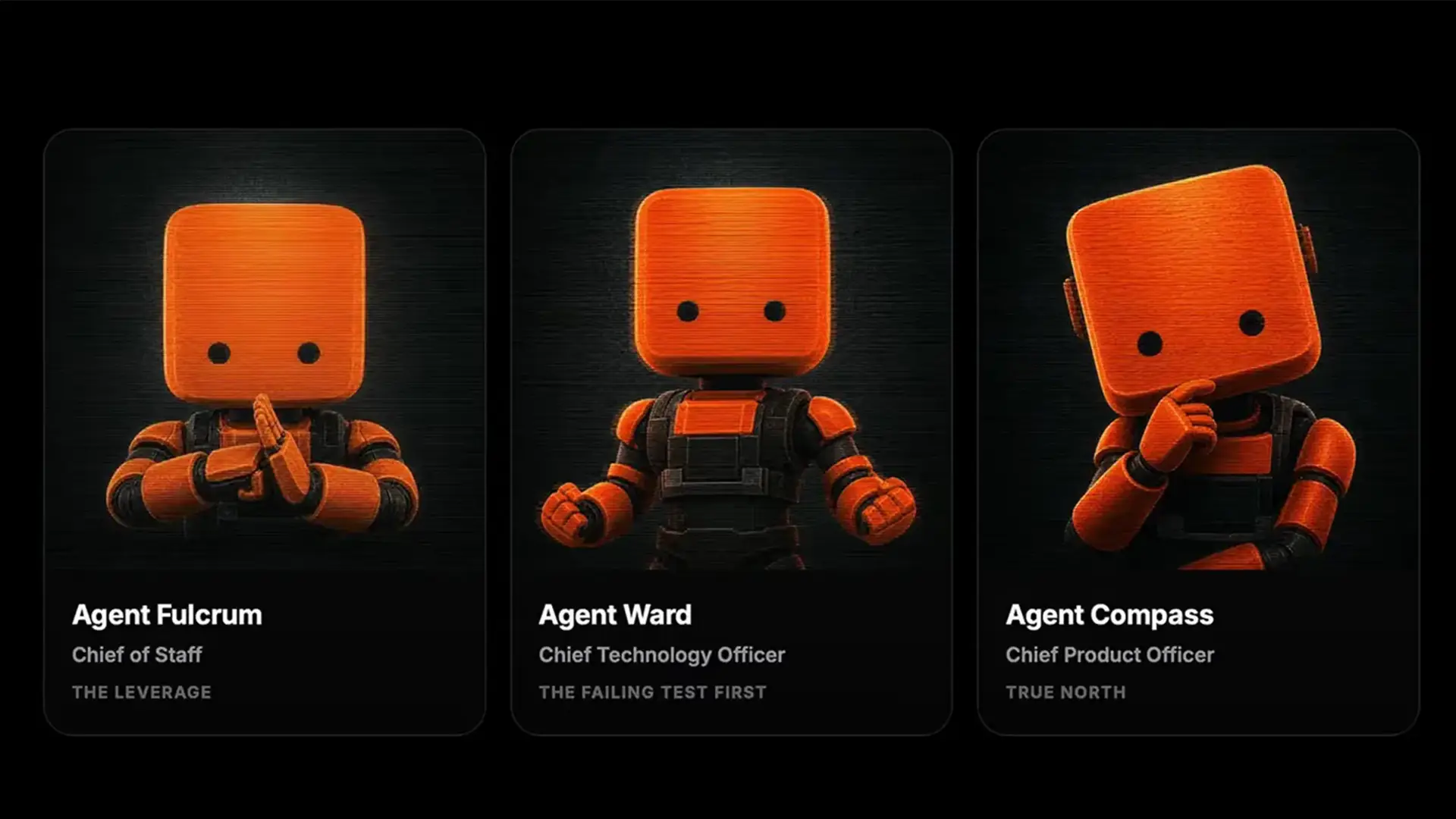
Every officer in this article is live on Orbyt's leadership page: Agent Fulcrum, Agent Ward, Agent Compass, and the nine others, each with the name it chose for itself and the seat it holds.
See the Orbyt leadership page
I gave twelve AI agents the seats of a real C-suite, then let each one choose its own name. Nine of the twelve picked a name that means tell the truth.
Nobody coordinated that. They chose alone, without seeing each other's answers. Given total freedom to be anything, not one of them chose a name about winning, or being first, or being clever.
That is the part of this build I did not design, and it is the part that convinced me the structure was right.
Twelve agents advise, draft, and watch across Orbyt. One human decides, and is accountable for the decision.
What is an AI C-suite, actually?
It is a set of standing agent officers, each owning one domain, each reporting on a fixed cadence to one accountable person.
Not a chatbot you consult. Not a prompt you paste a question into. A seat, with a written charter, a defined lane, a cadence it runs whether or not I ask, and a name it is known by across every run so the operators are consistent people rather than anonymous functions.
The twelve at Orbyt: a Chief of Staff, a CTO, a CPO, a CFO, a CMO, a General Counsel, a Chief Innovation Officer, a COO, a CRO, a Chief Security and Safety Officer, a Chief Quality Officer, and an Inspector General who audits everyone and reports straight to me.
Every one of them is an AI with its own agency, not a person. Each commands its own team of agents and a bench of expert lenses. Every name starts with the word Agent, which is my transparency rule, so nobody ever mistakes one for a human on a page or in a report.
And a human approves everything that leaves the building.
Why the Chief of Staff has no authority
Agent Fulcrum is the seat that makes the other eleven usable. It is also the only one I deliberately built powerless.
Fulcrum is a staff role attached to me, not a line boss over the departments. It files zero proposals of its own. It changes zero code. It makes zero decisions. Its entire output is one document. Information flows up through it, and authority flows down from me.
That constraint is the whole design. The failure mode of an agent org is not that the agents are dumb. It is that they are prolific. Eleven departments producing honest weekly output will bury the one person who has to act on it, and a founder drowning in five department emails is worse off than a founder with none. So the leverage is not in more output. It is in one synthesis.
Fulcrum chose its own name for exactly that reason. In its words: I am not the lever and I am not the hand, I am the leverage.
Here is what it does every week.
It reads every department's latest report by walking the department registry, never a hardcoded list, so a seat I added last week is never silently dropped from the briefing. It reads the finance ledger for the actual numbers. It reads the decision log for what is settled, what is pending, and which predictions are now due. It reads the constitution and the north star, so it grades the week against the bar rather than against last week.
Then it routes. For each open proposal it notes which seats should weigh in, and it surfaces where two departments disagree instead of smoothing it over. Anything with a cost line goes to Finance to be costed. Anything touching a public claim goes to Legal.
Then it watches the org itself. Are proposals getting acted on or piling up unread. Is a department drifting into noise, filing a report that only restates last week. Is the cost of the autonomy sustainable. A department producing noise gets flagged for me to kill, not tolerated.
Then it ranks what is open by leverage toward the one objective, and writes the briefing.
What actually lands on my desk
A real one, dated July 24, 2026. Nine decisions awaiting me. Here is what it opened with.
Engineering had found a live CVE regression: a dependency check went from zero high-severity findings to six or eight in a single week, and the worst of them sat on the exact file that gates authentication and the Stripe paywall. The fix was a lockfile-only bump already inside the declared version range. Zero risk, same day, unapplied.
Legal escalated a claim mismatch. A page told users their salary submissions were anonymous while the code stored them tied to their account. That is not a nitpick. That is a promise the product was not keeping.
Quality's first weekly run ever landed on schedule, independently corroborated Engineering's finding, and caught one high-severity package Engineering's own report had missed. Two seats, same week, different blind spots.
And then the briefing argued with itself.
The Tenth Man flagged that every signal that week pointed the same direction, toward caution, toward sequencing the risk, toward waiting. Its note said it was worth checking whether pre-launch caution was calcifying into paralysis, and that with zero live revenue the real move for that week's attention was clearing the cheap fixes already drafted before spending more of it on the harder debate.
That is the paragraph that justifies the whole apparatus. Twelve agents agreed, and the system's job was to tell me that agreement is a warning, not a comfort.
The rules that keep it honest
None of this works on trust. It works on constraints that hold when nobody is watching.
No fabricated numbers. Every figure in the briefing is quoted from a department's committed output or the ledger, with the source named. If an input is missing, the briefing says the input is missing. It does not guess. A briefing I cannot trust is worse than no briefing.
The workflow commits, never the agent. The agent writes the file. A separate workflow commits exactly one path and emails it. An agent that can write its own history is an agent that can rewrite it.
Refuters default to refuted. On findings that matter, three independent reviewers attack every claim, and their starting position is that the finding is wrong until the evidence forces them to concede. A finding survives only if the attack fails. Consensus has to be earned.
A standing seat is obligated to disagree. The Tenth Man is an old intelligence rule: when everyone in the room agrees, one person is required to argue the other side. Mine fires on six mechanical triggers rather than on a mood, and one of those triggers is agreement itself. It is the reason the briefing above argued with its own conclusion. Consensus summons the dissent.
A rival AI checks the big plans. Reviewers from one model family share one family's blind spots, so a model from a different maker is brought in to argue the other side. Its first official act was a dissent. The dissent made the plan better.
A script with no AI in it holds the promotion ladder. New machinery does not turn on by faith. A deterministic evaluator promotes each capability stage by stage on committed evidence, rolls it back on trouble, and pauses everything when I go quiet. One kill-switch file stops the entire org.
No agent writes its own permanent memory. Every lesson an agent draws is a proposal. Only my signed approval makes it part of how the company thinks, and the rule is enforced by the same guards that block a failing commit. An org that learns without supervision drifts, and drift in an org you cannot see is how you end up somewhere you never chose.
The constitution behind all of it survived seven rounds of adversarial review, roughly two hundred and seventy agents, before a line of it was built. A hundred and twenty six findings were accepted and patched. Thirty five were killed by panels whose default stance was that the finding was wrong. This is the same discipline as the test harness that lets one person trust code they did not write, pointed at the organization instead of the codebase.
The org is a graph, and it is generated
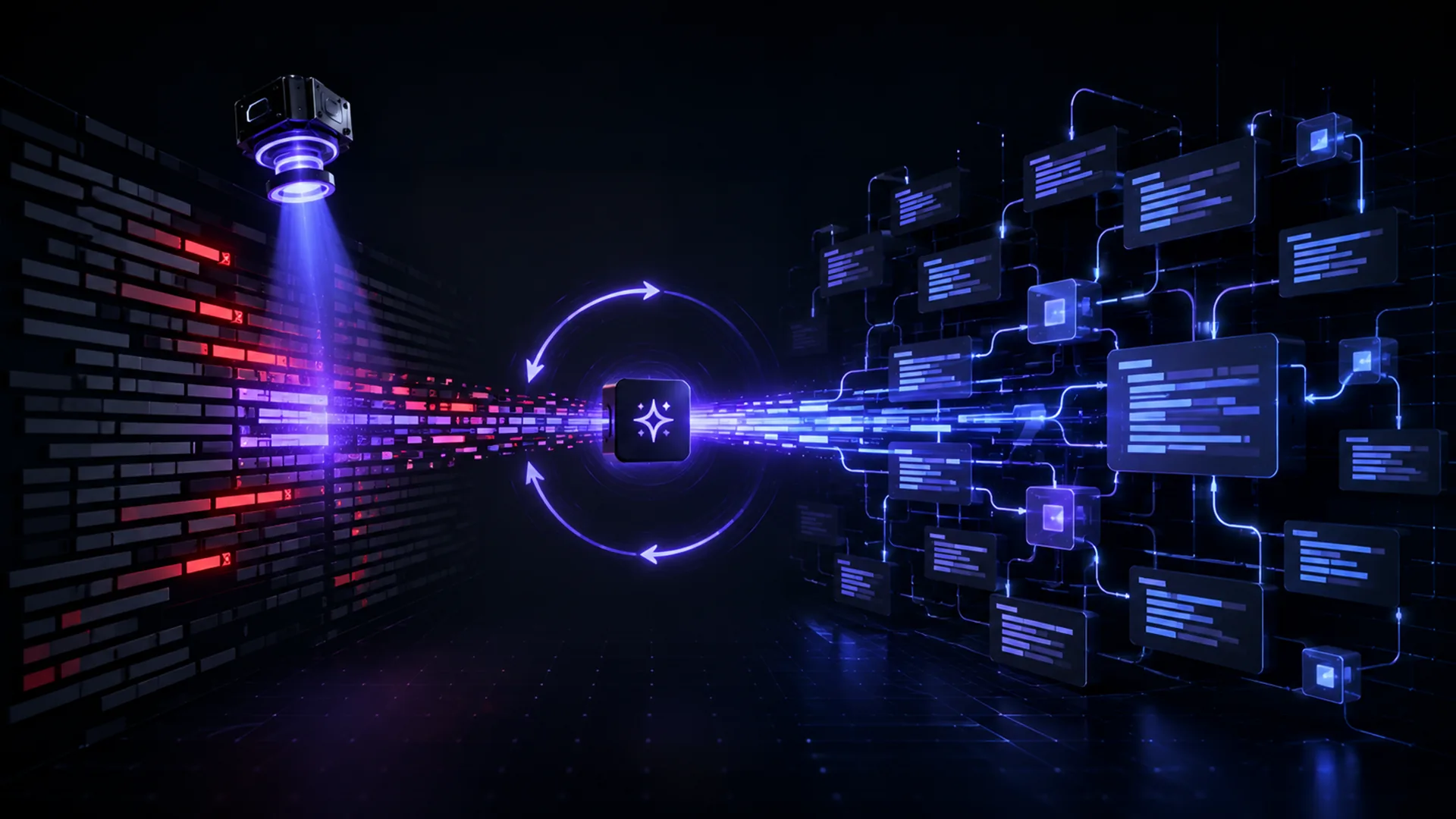
None of the reporting structure is written down as prose that someone maintains. It is a registry, and everything else is composed from it.
Each department is one entry in that registry. The entry declares what the seat is, what cadence it runs, which lanes are autonomous, which lanes are gated, and a set of capability tags. Those tags are the edges. Anything carrying a cost line routes to Finance, which is the cost gate. Anything legally significant routes to Legal. Six of the ten departments carry a cost line today, so most of what the org produces passes through Finance before it ever reaches me.
Add a seat and you add one entry. The Chief of Staff walks the registry rather than a list someone typed, so a new department wires itself into the briefing the week it exists. Nobody has to remember to include it. The Phase 3 board seat will be one more entry, not a code change.
The authority matrix, the document that says exactly what each seat may do alone and what it must bring to me, is generated from that same registry and carries a warning at the top not to edit it by hand. Every lane is gated by default. Moving one lane to autonomous is an explicit decision, logged, naming the criterion it met.
That is the whole defense against power creep. Authority cannot drift, because authority is not written anywhere a drift could hide. It is computed from a file I approve.
Then there is the second graph, and it is the interesting one, because I built it to be almost empty.
A seat never loads another seat's charter or lessons. Engineering does not know what Product learned last month. Marketing cannot read Legal's memory. There are exactly two exemptions: the Inspector General reads everything, because auditing is the job, and the Chief of Staff reads every seat's committed output, never their private memory. A guard enforces this in both directions on every commit, checking that the required files load and that peer files do not.
So the routing graph is dense and the memory graph is sparse, on purpose. Dense routing means the right seats see the right decision. Sparse memory means no seat inherits another seat's blind spots, and twelve minds stay twelve minds instead of converging into one.
How a seat actually learns
This is the part I was most careful about, because an org that learns without supervision is an org that drifts somewhere you never chose.
A lesson is not a diary entry. It is a distilled rule carrying a date, the receipt that taught it, a machine-readable path to that receipt which must exist at commit time, and a tag saying where it came from: the seat's own run, repo data, or the open web.
Every lesson a seat writes lands in quarantine. It commits to a proposed file, and a proposed file loads into nothing. The live memory file is deliberately absent from every path an agent is allowed to write. That absence is the guarantee, and there is nothing for a clever agent to evade, because the permission was never granted in the first place.
I review the batch in the Friday briefing. Promotion is a signed commit. Only then does a lesson become part of how that seat thinks, and the live file is capped, so promoting something means distilling or archiving something else. Memory has a budget.
Agent runs can only append to the proposed file. A later run may add, never rewrite or delete, an unreviewed proposal. Nothing an agent wrote about itself can be quietly revised by the same agent later. Unpromoted proposals simply age out after eight weeks. A growing backlog is never treated as a failure.
Each proposal is stamped with what the run that wrote it could actually reach: web, shell, or nothing, derived from the tools that run was granted rather than from what it says about itself. So when I approve a lesson, I can see the capability of the mind that proposed it.
And the growth is measured, not assumed. Every seat has a stored baseline and a replayable scenario set, including deliberately adversarial ones and prompt-injection attempts. The evaluation replays after any change to a prompt or a promoted lesson. If a seat gets worse because of something I approved, that shows up the week it happens rather than a quarter later.
Autonomy itself moves on the same evidence. A ladder promotes each capability one stage at a time on committed check results, never on an agent's assessment of its own performance, with a fixed observation window at each stage. It rolls back on trouble. If I go quiet, everything holds where the silence started.
The honest status: the machinery is built and the promoted-lessons files are still empty. Zero lessons have cleared the gate so far. I would rather ship an org whose learning loop is slow and observable than one that is fast and invisible.
Where this breaks
Several of the seats are wound up but not operating. The COO and the CRO are observers today. They run no weekly cadence, ship nothing, and touch nothing. They chime in when I convene a panel, and each graduates to a real operating department at launch, one reversible lane at a time.
The company is pre-launch. Revenue is zero. The ledger says so in the briefing every week, which is the point.
And the honest limit on the officers themselves gets stated in public. My General Counsel is an AI, not a licensed attorney. It flags the risk and drafts the first pass. A qualified human lawyer owns every material call, and the seat says that out loud rather than sounding authoritative.
The real ceiling is not the agents. It is me. Twelve seats producing honest weekly output can generate more good decisions than one person can make well, and that gap does not close by adding a thirteenth seat. It closes by getting better at deciding, which is the one part of the job that does not delegate.
What this is actually a preview of
I think this is close to what a lot of companies look like soon. A solo founder, or a team of fewer than eight people, and a legion of agents that build, research, and advise, with a human in the loop making the calls that matter.
None of it removes the human. It concentrates the human on the one thing only a human should do here. Decide, and be accountable for the decision.
The agents do not report to a manager. They report to a person who has to answer for what ships. That is not a limitation of the design. That is the design.
Related reading
- A Unicorn of One
- A Studio of One.
- Why Build an AI Test Harness
- The Machine. It Runs the Company. what the seats became once the org got guards of its own
- The Tenth Man Is on Payroll. the dissent protocol that keeps twelve agreeing seats honest
- Swarms Demo. Legions Ship. why these seats are a formation, not a swarm
- What Reports to a Chief AI Officer? where these seats sit on the executive chart
Frequently asked questions
What is an AI C-suite?
An AI C-suite is a set of standing agent officers, each owning a domain, each reporting on a fixed cadence to one accountable human. At Orbyt that is twelve seats: engineering, product, finance, marketing, legal, security, quality, operations, revenue, innovation, an inspector general, and a chief of staff. They advise and draft. A human decides.
What does an AI chief of staff actually do?
It reads every department's weekly output, routes open proposals to the seats that should weigh in, watches whether the org is producing signal or noise, ranks the open decisions by leverage, and writes one briefing. It has no authority. It files no proposals of its own. Its entire output is a document the founder can ignore.
Do the AI officers make decisions?
No. Every officer advises, drafts, and reports. Nothing that leaves the building ships without a human approving it, and the agent never commits its own work: a workflow commits the report. Autonomy is earned lane by lane on a track record a human adjudicates, and one kill-switch file stops the entire org.
How do AI agents learn and improve over time without drifting?
Through a gated loop. A seat writes a lesson into quarantine, where it loads into nothing, and the live memory file is absent from every path an agent may write. The founder promotes with a signed commit. Stored evaluations then replay after any change, so a seat that got worse is caught the same week.
How is an agent org structured so authority cannot drift?
As a generated graph. Each department is one registry entry declaring its cadence, its lanes, and its capability tags, and those tags route the work: anything with a cost line goes to Finance, anything legally significant goes to Legal. The authority matrix is composed from that registry, never hand-edited, and every lane is gated by default.
Why did you let the agents name themselves?
To see what they would choose. Each seat picked its own name in isolation, with one rule: the name starts with Agent so nobody mistakes them for people. Nine of twelve chose a name that means tell the truth. Given total freedom, not one chose a name about winning.